Spreadsheets are free. Sticky notes on a floor plan don't cost a subscription fee. For a lot of coworking spaces, serviced offices, and corporate real estate teams, that's exactly why manual workspace management sticks around long after it should have been replaced, it looks cheap.
It isn't. The real cost of managing a workspace by hand just doesn't show up on an invoice. It shows up in wasted square footage, hours lost to admin work, and decisions made on gut feeling instead of data. Below is a breakdown of where that cost actually hides, and a simple way to put a number on it for your own building.
1. Why manual workspace management feels free, but isn't
When a workspace is run on Excel trackers, printed floor plans, and someone's memory of who sits where, the costs are diffuse. No single tool or vendor is billing you for the inefficiency, so it never lands on a budget line. That makes it easy to ignore and hard to defend against when someone eventually asks, "why don't we just use a spreadsheet?"
The honest answer is that manual workspace management doesn't eliminate cost, it just spreads it across your team's time, your unused square meters, and your members' or employees' experience.
2. Where the hidden costs actually come from
Underutilized space. Global office utilization currently averages around 40–43%, with even top-performing offices in the US only reaching about 54% in 2025. That means roughly half of the desks and rooms a company pays for sit empty on any given day, and without real occupancy data, there's no way to right-size a lease or reconfigure a floor around it.
Administrative hours. Updating a spreadsheet every time someone moves desks, a team reorganizes, or a booking changes adds up fast. Facilities teams running manual processes routinely report spending hours each week just keeping floor plans and trackers current, time that doesn't show up as a line item but absolutely shows up in payroll.
Double-bookings and no-shows. Manual booking systems (or no system at all) create friction: rooms get booked twice, desks get "claimed" and never used, and nobody finds out until someone's standing in a doorway. Every no-show is space paid for and not used.
Bad real estate decisions. Without reliable usage data, decisions about renewing a lease, adding desks, or cutting a floor get made on assumption rather than evidence. Getting that wrong in either direction, overpaying for space you don't need, or under-provisioning and frustrating your team, is one of the most expensive mistakes a workspace can make.
Member and employee experience. Confusing booking processes, inaccurate floor plans, and visitors who don't know where to check in all quietly erode trust. For coworking operators, that shows up in churn. For corporate teams, it shows up in employees who stop coming to a workspace that never quite works the way it should.
3. A simple formula to calculate your hidden cost
You don't need a data science team to put a rough number on this. A useful starting framework:
- Space waste = (Total desks/rooms × average vacancy rate) × cost per desk or room per month
- Admin time waste = (Hours per week spent on manual tracking × hourly cost of that role) × 52
- Booking friction cost = (No-shows or double-bookings per month × average cost per booking, including staff time to resolve it)
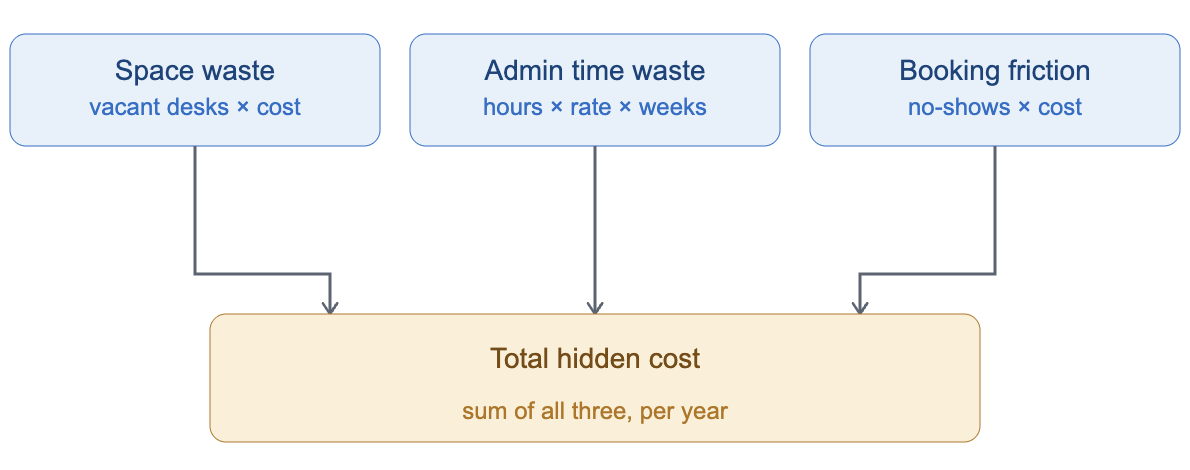
Add the three together and you get a conservative annual figure for what manual workspace management is actually costing, before you even account for churn, poor lease decisions, or the opportunity cost of a facilities team spending its time on data entry instead of strategy.
For context: some analyses put potential savings from optimizing workspace usage at thousands of dollars per employee per year once occupancy data replaces guesswork. Even a modest reduction in wasted space or admin hours tends to justify the cost of proper workspace management software many times over.
4. How workspace management software closes the gap
This is exactly the problem workspace management software is built to solve. Instead of a spreadsheet that goes stale the moment someone moves desks, a proper workspace management platform gives you live occupancy data, automated bookings, and reporting that turns "we think" into "we know."
Zapfloor was built around that shift. As workspace management software used by coworking spaces, serviced offices, multi-tenant buildings, and corporate teams across Europe, Zapfloor replaces the manual layer, the trackers, the printed floor plans, the guesswork, with real-time space and desk booking, automated check-in, and usage analytics that show exactly which areas are overused, underused, or ready to be reconfigured.
The result isn't just fewer administrative hours. It's a workspace where decisions about space, cost, and layout are based on what's actually happening on the floor, not on what a spreadsheet said three months ago.
The takeaway
Manual workspace management rarely feels expensive in the moment, that's precisely what makes it expensive over time. Run the numbers on your own space waste, admin hours, and booking friction, and the case for structured workspace management usually makes itself. If you want to see what that looks like on your own floor plan,
Zapfloor is a good place to start.