European Mobility Week runs from 16–22 September 2026 under the theme "Mobility for Everyone," and it lands at an odd moment for offices. Most companies have settled into some hybrid rhythm, but the question underneath it hasn't moved: how do people actually get to work, and what is that costing them, their employer, and the city around them?
For facility and workplace managers, that question isn't abstract. It shows up in vacant desks on Mondays, in requests for locations closer to home, and in sustainability reports that need a credible story about transport emissions. Flexible workspaces (coworking hubs, satellite offices, multi-tenant buildings) are one of the few workplace decisions that touch all three at once.
What European Mobility Week is, and why the 2026 theme matters
European Mobility Week is the European Commission’s annual campaign encouraging towns and cities to test and promote sustainable transport, running every year from 16 to 22 September and closing with Car-Free Day. In 2026, more than 2,500 towns and cities are taking part under the theme “Mobility for Everyone,” with Commissioner Apostolos Tzitzikostas framing it around intergenerational fairness: transport that works regardless of age, income, location, gender or ability.
Activities this year include Car-Free Day events, expanded 30 km/h zones, new bicycle infrastructure, and local programmes aimed at getting more people out of cars and onto public transport, bikes or their own two feet. For workplace teams, the campaign is a useful annual prompt: it’s the week people expect employers to talk about how they get to work, not just where they work from.
The hidden cost of the commute
Commuting hasn’t disappeared with hybrid work, it has just become less predictable to plan around. The average European commute is around 48 minutes a day, but that average hides sharp national differences.
48 min
EU avarage daily commute
61 min
Belgium, Europe's longest
13%
of Belgian workers are "super-commuters" (2+ hrs/day)
14%
travel over 120km per day
Interestingly, only 34% of Belgian workers call that time wasted, and demand for full remote work sits below the international average. People aren’t asking to stay home; they’re asking for the commute to make more sense.That’s the gap flexible workspaces are built to close: not eliminating the office, but putting one closer to where people actually live.
How flexible workspaces cut commute time, cost, and emissions
Coworking and flexible workspace operators solve the commute problem by changing where the desk is, not whether one exists.
- 65%
office space after adopting a distributed model (Search for Common Ground)
- 80%
real estate spend after going distributed (T-Mobile)
€9.5k
average annual saving per employee working closer to home half-time
~500t
saved yearly cutting 200 commutes from 45 to 9.6 km
For European Mobility Week specifically, this is the argument that connects facilities strategy to sustainability targets: a shorter, more flexible commute is one of the few workplace changes that reduces emissions and cost at the same time, rather than trading one for the other.
The hub-and-spoke model: turning a portfolio into a mobility strategy
The clearest way to operationalise this is the hub-and-spoke model: one central headquarters for high-stakes collaboration, supported by smaller flexible or coworking locations positioned near where employees actually live.
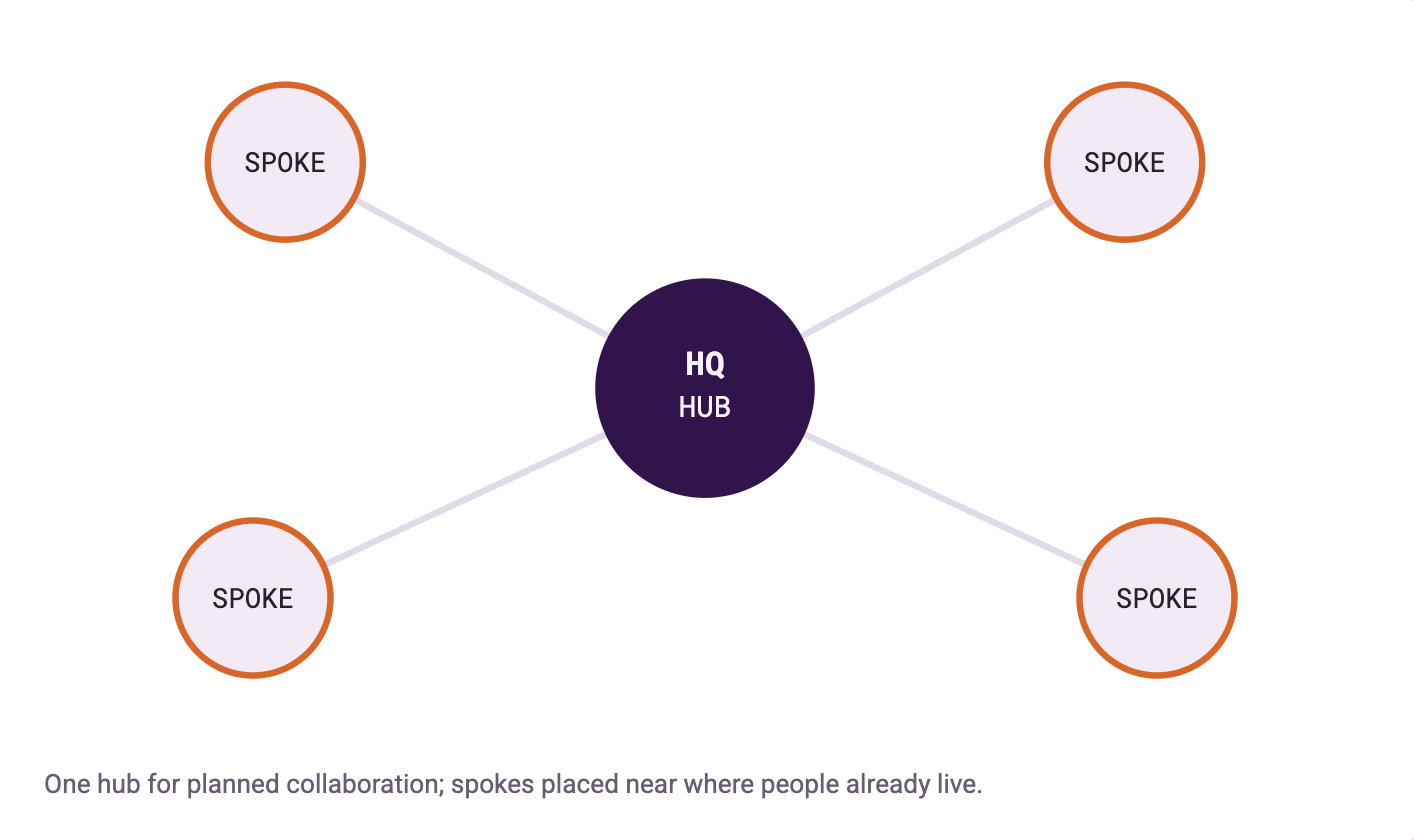
Instead of everyone travelling to a single address, a product designer who once flew or drove across the country for a few days a month can walk into a nearby flexible space instead. For facility and workplace managers, this isn’t just an employee-experience decision, it’s a portfolio decision:
Map where employees actually live, not just where the head office sits, before deciding where the next spoke should open.
Widen the talent pool beyond a 30-mile commuting radius of any single site.
Treat hub days as intentional, structured collaboration time rather than default full-time attendance.
Report commute-related emissions savings as part of existing ESG or facilities reporting.
For multi-tenant and flexible workspace operators, this trend is also a growth signal: every company adopting a hub-and-spoke model is a company that needs a flexible, well-run location near its people.
What this means this Mobility Week
16–22 September is a natural moment to put this into action rather than just talk about it:
Audit commute patterns, not just attendance: where people travel from, not just how often they badge in.
Map spoke locations against employee postcodes, and treat clusters of long commutes as a signal to open or book a closer space.
Use Car-Free Day (16 September) as a trial: encourage teams near a flexible hub to work from there instead of driving in.
Track utilisation across every location, not just the headquarters: an unused location isn’t reducing anyone’s commute.
Fold the numbers into existing sustainability reporting, since commute savings are increasingly expected in ESG disclosures.
None of this works well from spreadsheets once a portfolio spans more than one or two sites. Zapfloor’s workspace and multi-tenant management platform gives facility and workplace managers one place to see occupancy, bookings and utilisation across every flexible location, so a hub-and-spoke strategy stays measurable instead of anecdotal.
Explore ZapfloorThe takeaway
European Mobility Week is a one-week campaign, but the commute problem it highlights runs all year. Flexible workspaces won’t fix congestion on their own, but they’re one of the few tools facility and workplace managers already control that can shorten commutes, cut emissions and improve retention at the same time. The operators and companies that treat their flexible footprint as a mobility strategy — not just a real estate line item — are the ones who’ll have a genuine answer when Mobility Week asks the question again next year.


